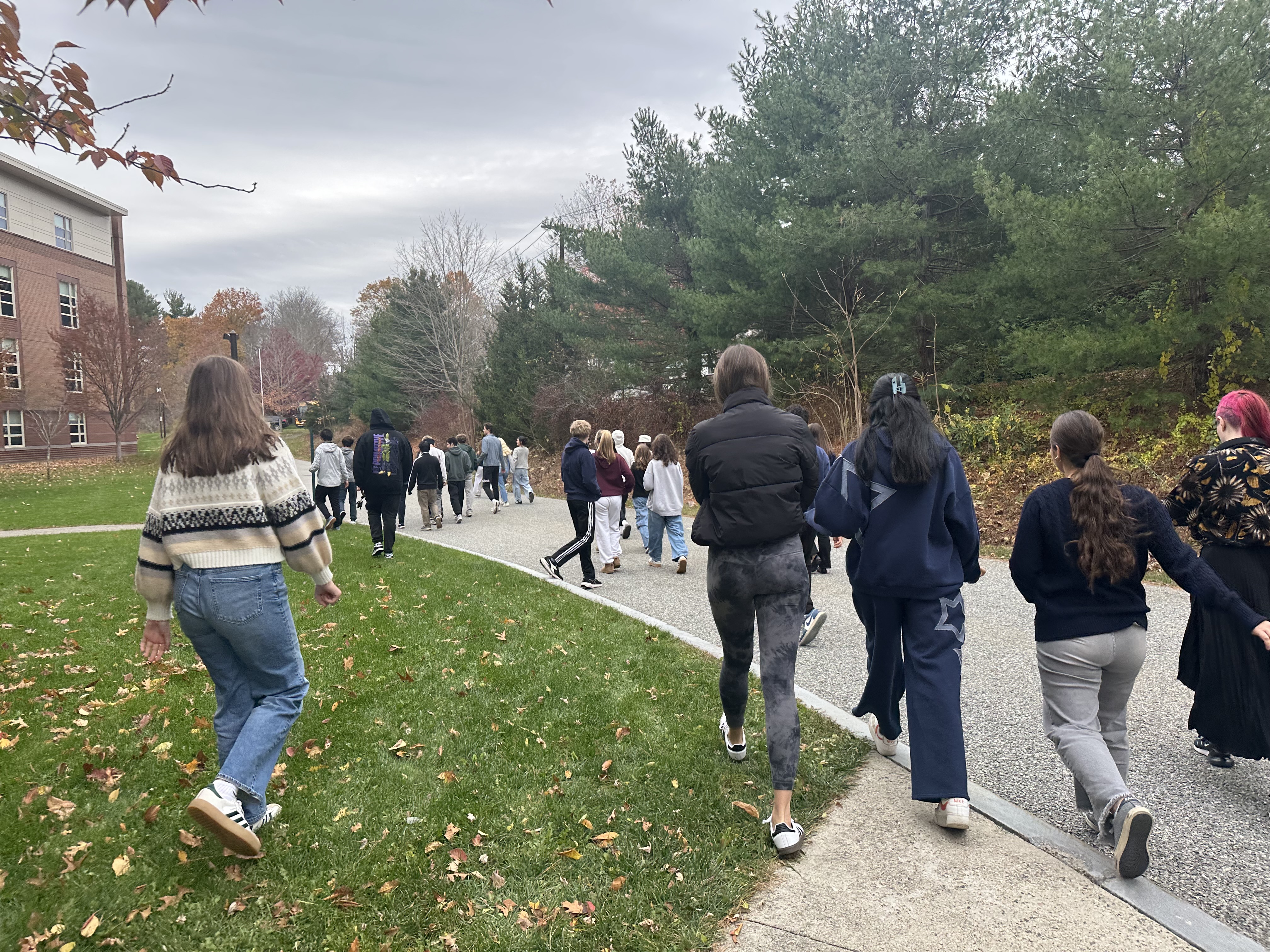
On November 5, students at the high school trudged into advisory and were met with “ALICE” spelled out in block letters and posted on Smartboards. For many, this was a familiar sight that signified the safety drill hosted by the Wellesley Police Department each year.
Meant to prepare students for potential threats inside the building, the drill endeavors to teach students the ALICE acronym — and put it into practice. ALICE, which stands for Alert, Lockdown, Inform, Counter, and Evacuate, is one of many strategies that attempts to simplify and standardize the response to active shooters.
Every year, students first watch a video explaining each letter of the acronym and then participate in a lockdown and evacuation drill to simulate a reaction to an active shooter in the building. The school began running these drills in 2014 in response to increased K-12 school shooting incidents.
“The likelihood of an active shooter event happening here is low,” said School Resource Officer Matthew Wall. “Over the years, [though], we’ve seen an uptick across the country of active shooter events. So it is a reality of our world. And like anything else, the more you train for something, the better prepared you are.”
Wall, who manages the drill at the high school and is ALICE-certified, runs it every year due to its potential to save lives.
“I’ve seen how this program works and I know that it has kept people safe, so I believe in it,” he said. “Statistically speaking, most active shooter events end before law enforcement can arrive. ALICE is a proven tool to keep the majority of people safe.”
For the administration, teaching ALICE is part of a larger plan surrounding active shooter events — one that prioritizes prevention. Dr. Jamie Chisum, principal of the high school, referred to the house model, advisory, and the counseling department as means of support for struggling students.
“Those [initiatives] blossomed in the period of time between Columbine and what we would think of as our current iteration of safety training,” said Chisum. “All of those pieces were part of it and continue to be part of it as we move forward.”
Some students find the drill tedious, however, and don’t take it seriously. Others are alarmed by this flippancy.
“Nothing has happened in Wellesley that makes people care, so the drill has turned into just this thing we do every year,” said Addison Kinney ’26. “A lot of people treat it like a fire drill. But it’s very different.”
Wall echoed the idea that people might be discouraged from participation due to the low likelihood of an active shooter event.
“A lot of people think the thought of someone coming into a school to do that is just unthinkable. They’re not wrong. It is unlikely,” said Wall.
Nonetheless, Wall finds the drills essential to establishing familiarity with the ALICE procedure, comparing them to fire drills in effect.
“You do [fire drills] twice a year. That doesn’t mean you expect a fire to break out the next day. But if there ever were to be a fire, it’s muscle memory. Your body knows what to do,” he said.
For faculty, the school tries to build this muscle memory even more realistically. While Chisum announces a mock-location where a “shooter” is located during the student training, it lacks the realism of the faculty drill.
On October 16, teachers stayed late after school for their training. They first watched the same ALICE video. Then, Wall and fellow School Resource Officer Kathy Poirier presented each part of the acronym and fielded questions. Lastly, faculty returned to their classrooms for the immersive practice. An officer walked throughout the building, firing blanks in stairwells and common “lobby” areas on each floor.
“The shooting of the blanks [during the faculty drill] is helpful because you can hear what it sounds like…If I heard it now, I would know exactly what it is,” said Mr. Zachary Nicol, a social studies teacher at the high school.
For the administration, the focus of the faculty drill is to ensure that, in the event of an active shooter, students have leaders to look to.
“It’s really important that the adults are really trained and that they get all their questions answered,” said Chisum. “The adults really need to know what they’re doing.”
In this way, the student drill also serves as a second practice for teachers to make crucial decisions based on the shooter’s location.
“I usually talk to the police officers ahead of [the student training] and say, where should we go this year? And then it forces the teachers to do a different calculus,” Chisum said.
However, the faculty drill this year was blemished by what Chisum recognized as an administrative mistake: due to the timing of the exercise, the volleyball teams were waiting outside the cafeteria for their bus to an away game when the blanks were fired.
For much of the team, the response to hearing the drill was curiosity — running up to the windows and peering in at the shooter.
For Kinney, though, the reaction was different. Before moving to Wellesley, she lived in St. Louis, where her school experienced multiple gun threats. This previous experience gave Kinney a different outlook on the drill.
“When the first gunshot happened, I had to leave and sit away from the windows because I didn’t want to watch,” she said. “[Having experience with this] just gives you so much perspective that I think a lot of people in Wellesley don’t have. And you can’t get that perspective without experiencing it yourself.”
Kinney’s reaction speaks to one of the reasons the administration does not hold the same depth of drills for students.
“I am protective that you’re still kids. And there are triggers that can happen for kids. I don’t think [more intense training] is worth it,” said Chisum. “I don’t want to take the risk of upsetting a kid to the point where they…don’t feel as safe coming back here.
Indeed, the school’s ultimate goal is safety, both in feeling and in reality.
“How do we keep our kids safe and not ruin an environment where kids…feel happy to come to school and don’t feel threatened?” said Chisum. “That’s a balance we want to strike — keeping everybody safe, but also having them actually feel safe.”