
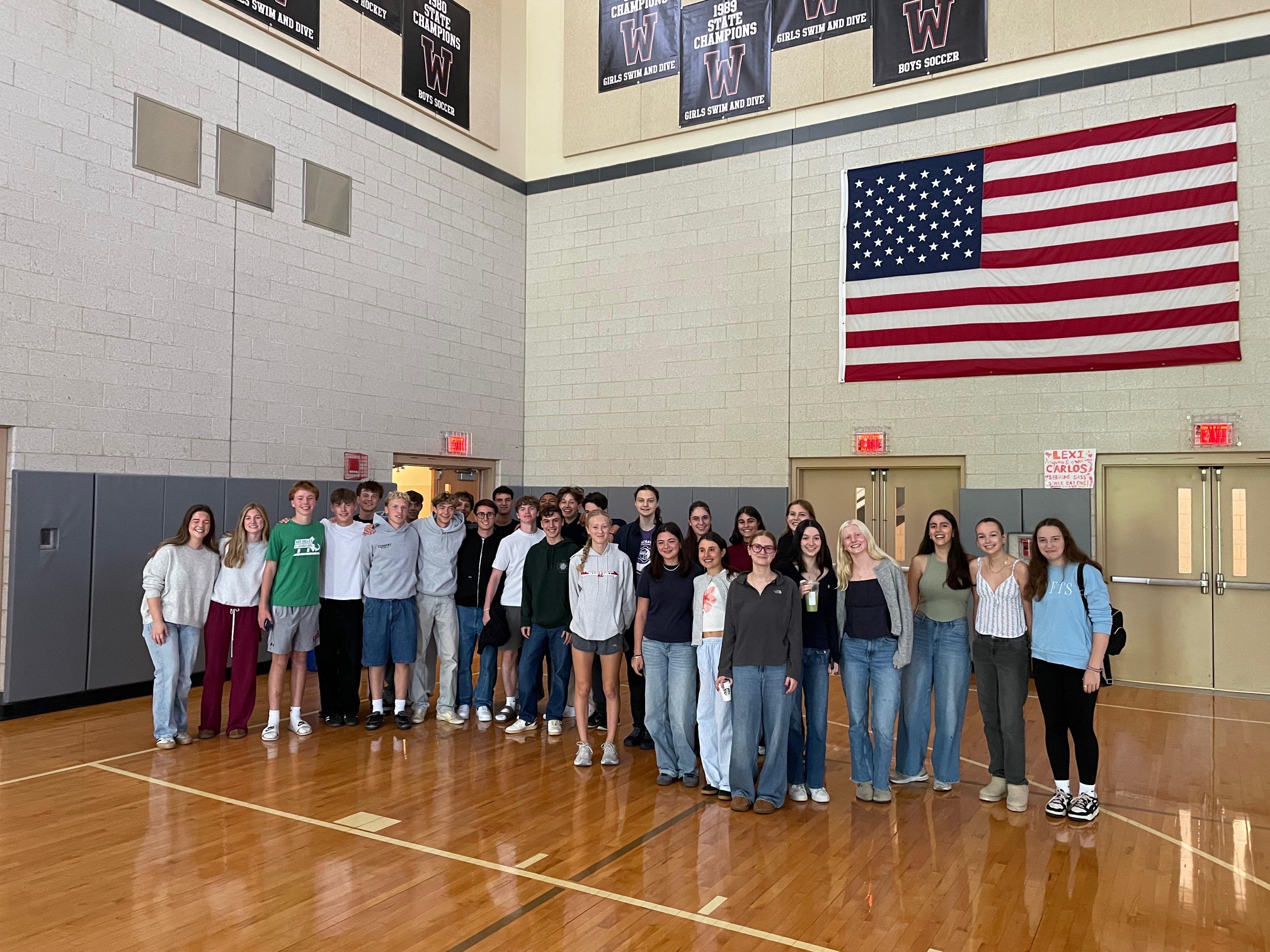
This September, fifteen students from Wirtschaftsgymnasium Basel-Stadt (Basel Business School) in Switzerland arrived in Wellesley to spend two weeks living with a host family. Each exchange student was partnered with a student at the high school and attended two days of classes in the building, spending the rest of their time exploring Boston and learning about the local culture and history.
Students visited landmarks around the city, including the Museum of Fine Arts, the Massachusetts State House, and the John F. Kennedy Presidential Library.
“We saw a lot of cool architecture and art in the art museum,” said Luana Gass, one of the Swiss exchange students. “We also visited Fenway Park, so I now know a lot about the Red Sox, too. [The visit] widened my horizons.”
For their American hosts, the program offers a chance to gain a new perspective on old experiences.
“[Hosting an exchange student] forces you to see the town in a different light,” said Mimi Vella ’26, a host student from the high school. “It’s been really fun bringing him to different school events like football games and different parts of Wellesley that I might not have chosen to go to. Hosting has encouraged me to get him out of the house and take him to new spaces.”
The program isn’t just an escape from the routine of school, but also a way to learn about foreign cultures, something that most never get to experience in such a personal fashion.
“Truly staying with a family and making a connection with someone from that country is a once-in-a-lifetime opportunity,” said Dr. Sylvia Kaczmarek, a co-coordinator of the exchange. “I think that connection is something you can’t get with tourist travel.”
Gass echoed this sentiment about the program’s personal nature.
“Even though we saw many tourist attractions, I was still able to see actual life in the US. It’s not like you stay at a hotel and then visit places and go back to the hotel,” Gass said. “If I was here with my family, I don’t think I would have realized a lot of the cultural differences I saw.”
The Swiss exchange is one of two exchange programs offered at the high school. The other program — the German exchange — is exclusively available to students taking German. The Swiss program, however, does not have any such prerequisites and differentiates itself from the other student trips at the high school.
“The art trip is awesome, but you don’t get to live with a family,” said Dr. Thomas van Geel, the other co-coordinator of the program. “And [the Swiss exchange] is a cultural exchange, not a language exchange, which makes it open to a wider range of students.”
The exchange’s cultural focus highlighted differences between the two countries for Swiss students, especially those who have not traveled to the United States before.
“[There are] a lot of elective classes here. Most of the classes in Switzerland are mandatory,” said Julian Senn, Vella’s exchange student. “Also, most of our classes are with the same people.”
Outside of school, Swiss students observed much less public transportation in Wellesley compared to their bus and train system.
“At home, we can just get from one place to another without needing to drive,” Gass said. “But here, without a car, it’s really complicated to get around.”
In April, the host students from the high school will be visiting their counterparts in Basel. Throughout their week-and-a-half in Europe, the exchange students will visit the ‘three countries corner’ in Basel, tour the capital of Bern, and experience the unique landmarks and history of Switzerland.
Though the exchange may be out of some students’ comfort zone, past participants praised it.
“It’s definitely a very ‘worth it’ experience,” said Cooper Reisner ’26, who took part in the program last year.
For Reisner, seeing his exchange partner in Switzerland was the highlight of the program.
“When we go to them, it’s like revisiting your best friend,” he said. “It really shows how much you’ve bonded with your person.”
Indeed, the Swiss exchange program fosters human connection between young people of different nationalities who would otherwise never cross paths.
“It helps you reflect on your own country and understand others,” said Kaczmarek. “At the end of the day people are not very different. A little more cultural and international understanding broadens our horizons so much.”

Riveting!