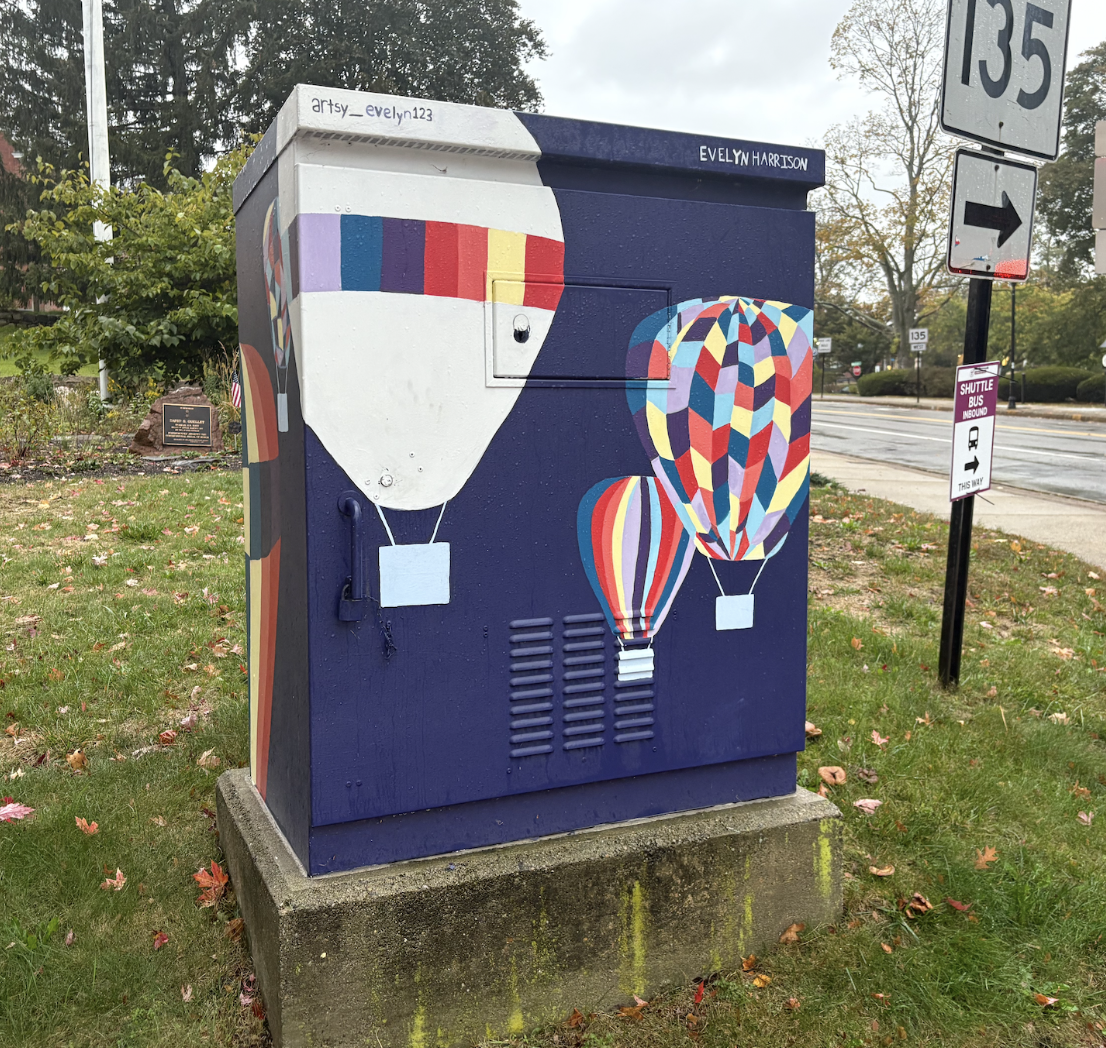
Flowers, sports equipment, birds, police cars, and silhouettes. These designs are scattered throughout Wellesley, painted on electrical boxes along sidewalks and roads. An effort that began during the COVID-19 pandemic, these electrical boxes are decorated annually by different Wellesley artists.
The electrical boxes throughout Wellesley are managed by the town’s police department. During the pandemic, former police captain Jack Pilecki decided to pursue an art program. He reached out to many local artists to form the Public Art Committee, which runs the project.
The committee first researched neighboring projects, as Boston and Brookline have comparable programs — PaintBox and Boxes Around Town, respectively — that allow artists to present their skills locally.
In Wellesley, interested artists must submit an application to the Public Art Committee, which reviews the submissions and votes to select the winning artists. Along with their proposed design, artists submit a title of the artwork and a description of the reasons or inspiration behind the proposal. Upon approval, they receive a $1000 stipend for time, transportation, and supplies.
Annie Newman, one of the original members of the committee, said, “We try to avoid anything overly political [when selecting winners], and of course, we are concerned with the craftsmanship or skill of the artist.”
Students at the high school have the opportunity to contribute their work to this service.
Evelyn Harrison ’25 was empowered by the opportunity. The electrical box at Whole Foods — created by her favorite artist, Mia Cross — inspired Harrison to apply to the program in eighth grade.
At the beginning of her freshman year, her piece Views From Above was selected for a box at Church Park. Influenced by Harrison’s favorite dress from middle school, Views From Above features an array of colorful parachutes, each with its own patterns and style.
“I wanted to tie in lots of vibrant colors to play with the liveliness of Wellesley Center and bring some whimsy to the drearier winter days,” said Harrison.
To her, public art is more than aesthetics.
“Beyond helping individuals, public art also has the power to instill a sense of community pride in that it represents a shared set of values and a common love of something beautiful,” she said.
Public art brings many benefits to towns. Neighborhoods with public art are perceived as safer than those without it, and thereby attract new residents and businesses. A survey conducted at two public art projects in London’s urban space revealed that 84 percent of participants believed that partaking in public art improved their well-being.
“I think public art is incredibly effective at making people live more presently because it is explicitly designed to make you stop and look around,” said Harrison.
In Wellesley, this impact is felt all around.
“Art enriches our lives. I think our increasing focus on the arts has helped to expand the lived experience in Wellesley,” said Newman.